Emergencies
Police/Fire/Ambulance - Call 911 first. Then call 815-802-8190 or 5555 from campus phones.
Non-emergencies
Call 815-802-8190
Safety Information & Training
Emergency Notifications
In cases of severe weather, utility outages or other circumstances, KCC will announce campus closings as far in advance as possible. For KCC classes offered at area high schools, if the school is closed for an emergency the class will be canceled. Students can learn of emergencies and closings several ways:
- All students and staff receive phone messages and emails when there is a college closure.
- To receive text messages from KCC, you must opt in:
- Log in to Self Service > Menu > User options > User profile
- Select "Add new phone" (under Phone Numbers).
- Add your number. For “type,” select “Receive KCC Text Alerts.” Message and data rates will apply.
- Chicagoland Emergency Closing Center posts KCC closing information.
- KCC home page and Facebook page post announcements.
- Local radio stations are notified of KCC closures and may announce them.
Fire & Severe Weather Emergencies
Fire & Severe Weather Drills
Each semester, KCC’s campus police department coordinates with local agencies to test fire and weather/disaster alarms and evacuation procedures. In order to maintain realism, some drills are not announced ahead of time.
When an alarm is heard:
- Fire alarms are one continuous alarm blast.
- Severe weather/disaster alarms are a voice message.
Safe Areas During Weather Emergencies
All tornado safe locations are only on the first floor.
In the event a situation takes place everyone will be notified through the college ENS (Emergency Notification System).
The following locations have been designated safe areas for weather emergencies including tornadoes:
South Extension Center
- Interior hallways and restrooms
North Extension Center
- First floor interior hallways and first floor restrooms
Manufacturing & Industrial Technology Center
- Interior hallways and restrooms
Riverfront Campus
Building M - Health Careers Center for Excellence
- M102
- M106
- M107
- M108
- M109
- M110
- M111
- M112
- M113
- M114
- M117
- M118
- M119
- M120
- M121
- M122
- M124
- M126
- M128
- M129
- M130
- M132
- M133
- M139
Building D - Workforce Development Center
- D121
- D122
- D123
- Men and women restroom front WDC and near kitchenette
- Storage room within the HR area
Building L
- L110 – Auditorium
- L114 – office
- L102C – office
- Restrooms near east elevator
Building T – Advanced Technology Education Center
- T103
- T113
- T114
- T115
- T117
- T123
- T125
- T127
- Men and women restrooms
Building V - Technology
- V107
- V110
- V112
- V114
- V116
- Men and women restrooms
Building W
- W103
- W106
- W108
- W109
- W110
- W111
Phone Bomb Threat Checklist
DHS Bomb Threat Checklist (PDF, 181KB)Active Shooter Preparedness
Review emergency response protocols and options when responding to an active shooter situation: Run, Hide, and Fight.
CISA Video: Options for Consideration (YouTube)
Portable Fire Extinguisher Training
Understand how to safely operate a fire extinguisher using the PASS technique (Pull, Aim, Squeeze, Sweep) and identify different fire classes.
Fire Equipment Manufacturers' Association Video: How to Use a Portable Fire Extinguisher (YouTube)
AED Operation & Cardiac Emergency Response
Learn the critical step-by-step procedure for operating an Automated External Defibrillator on an adult during cardiac arrest.
American Red Cross Video: How to Use an AED on an Adult (YouTube)
Sex Offender/Violent Offender Registration
Enrolled students who are sex offenders and/or violent offenders must register before the beginning of each semester with the KCC police chief or deputy chief. Phone 815-802-8190 or 815-802-8197.
The Victims of Trafficking and Violence Act of 2000 requires colleges and universities to inform students and employees how to learn the identity of registered sex offenders on campus. This law contains the Campus Sex Crimes Prevention Act, which became effective Oct. 23, 2002.
Sex offender information is compiled by the Illinois State Police, which maintains a website that allows you to search for sex offenders online. Learn the identity of registered sex offenders in Illinois by reviewing the sex offender database.
College Ordinances
College ordinances apply to all persons on property owned, leased and managed by KCC. Review the regulations policy document for a complete list of misconduct and fines. The general categories are:
- Alcohol and drug use
- Assault and battery
- Damage to property
- Disorderly conduct
- Fighting
- Gang representation and recruitment
- Misrepresentation/failure to identify
- Obstruction, resistance or interference with a KCC police officer
- Smoking
- Soliciting
- Theft
- Trespassing and unlawful access
For more information, contact any police officer.
ID Cards
Currently, enrolled students and KCC staff are required to have a KCC-issued photo ID card. Students must be prepared to present their cards to campus police and security officers and personnel in the Accounting Office, Admissions and Registration, Miner Memorial Library, bookstore, and other offices.
ID card photos can be taken during regular business hours at these locations:
- Admissions and Registration
- Room W102 - Prairie Building
- South Extension Center
- Adult Education Department (Adult education and English as a Second Language students only)
After the photo is taken, ID cards can be picked up in Room W102 or Admissions and Registration. To complete the ID process, students must bring their registration statement and one other type of photo ID (driver’s license, state ID, high school ID, FOID, etc.).
Credit students
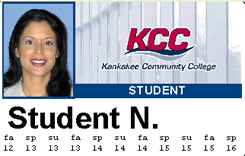
Credit students can use the card to
- Check out books from the KCC library and I-Share libraries such as Joliet Junior College, Olivet Nazarene University, Governors State University.
- Enter college-wide activities
- Check-in and out of KCC Fitness Center
Replacement cards - $5 fee for first replacement; $10 fee for each subsequent replacement.
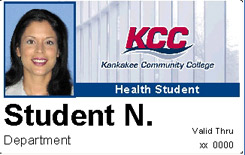
Health Career students
The health student card is used at off-site clinical locations only. It has no active barcode or magnetic strip. The card is valid only while the student is enrolled in the health career program.
Replacement cards - $5 fee for first replacement; $10 fee for each subsequent replacement.
Community students
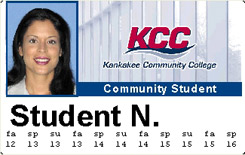
Adult Education/GED students, Upward Bound, and other high school grant program participants receive a community student ID card.
Community students can use the card to
- Check out books from the KCC library
- Enter college-wide activities.
Replacement cards - $5 fee for first replacement; $10 fee for each subsequent replacement.
Staff and faculty
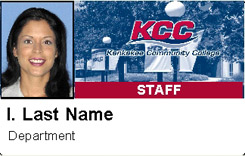
The staff card has an identification number on the barcode and in the magnetic stripe on the back. The card does not have an expiration date. Human resources will collect the card during the exit interview.
Staff can use the card to
- Check out books from the KCC library and I-Share libraries such as Joliet Junior College, Olivet Nazarene University, and Governors State University
- Use campus copiers
- Check-in and out at the KCC Fitness Center
- Enter college-wide activities
Replacement cards - $5 fee for first replacement; $10 fee for each subsequent replacement.
In the future, the card will allow access to select areas and doorways and establish foodservice accounts.
Community members
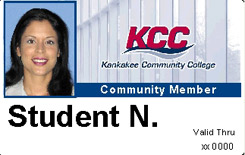
The community member card has an active barcode on the back. The card is valid for two years; the expiration date is on the card.
Community members can use the card to check out books from the KCC library.
$5 for the first card and for each replacement card.
Photo ID policy
This identification card must be carried at all times and presented to college officials when conducting business with the college.
The use of this card is governed by all Kankakee Community College regulations and is not transferable.
If presented by anyone other than the pictured cardholder, the card will be confiscated and all privileges revoked.
A lost, damaged, or stolen identification card must be reported to Room W102 or Admissions and Registration. There is a $5 fee for the first replacement and a $10 fee for each subsequent replacement.
This card remains the property of Kankakee Community College and is to be surrendered on demand by any college official
Law Enforcement Requests and Campus Access
Bevin’s Act Procedures
If a law enforcement officer or public official from any jurisdiction comes to campus requesting student information, they must present a signed Authorization for Release of Information form that includes an official notary seal from the State of Illinois or from the state where the request originated.
Federal or ICE Agents
For a federal agent, including an Immigration and Customs Enforcement (ICE) agent, to enter non-public areas (such as classrooms, offices, or residence facilities), they must present:
- A warrant signed by a judicial judge, or
- Consent from a college official or law enforcement, and only in exigent circumstances involving imminent danger.
An administrative warrant signed by an immigration official alone is not sufficient to enter private spaces.
Entry into publicly accessible areas (such as walkways or public events) generally does not require a warrant.
For off-campus athletic housing, a signed judicial warrant must be presented to the local law enforcement agency with jurisdiction.
Service of Warrants or Subpoenas
Law enforcement officers coming to campus to serve an arrest warrant or subpoena must:
- Contact the Chief of Police Eric Springer or Deputy Chief of Police Micheal Stoltz.
- Wait in a designated area once contact is made.
- The Chief or Deputy Chief will notify the appropriate college official, who will then consult College Counsel for guidance before any action is taken.
College Police Assistance
Officers from the KCC Police Department will not assist federal or ICE agents except in exigent circumstances involving imminent danger.